Last week I managed to obtain three walk through settlements at three different Boards in the same day – mostly due to the good will and kindness of Board staff and other attorneys. It was my plan to walk through a settlement in San Jose and then Oakland in the same morning to be followed up with an afternoon settlement in San Francisco.1
My morning walk through in at the San Jose WCAB was with an unrepresented injured worker. I had set my Board file and settlement documents down next to me and turned to speak to the injured worker – but when I turned back my Board file and documents were gone. An attorney had walked into the room, picked up my documents and Board file, put them in his bag along with his other materials nearby, and left for his office.
At this point, the dream was almost dead before it had even begun. Even if I managed to chase down my file which was now somewhere in San Jose, I only had a slim chance of finishing a walk through that morning and no chance of doing a second in the same morning.
I very nearly aborted the mission and returned to my office in defeat. Ultimately, I decided that I’d rather risk a spectacular failure than not try at all.
I called my office to get the phone number of the attorney I thought had picked up my file, called their office, and left a message asking for their attorney to call me back. He called me back a few minutes later and said my file was in his bag – he must have put it there accidentally. Unfortunately, his schedule didn’t permit him to bring the file back to the Board.
After apologizing to the injured worker and begging the forgiveness of the Judge, I left the Board and my really excellent parking space for the attorney’s office. I was probably inside their office for less than 30 seconds total since the attorney had left my Board file with his receptionist. Back to the Board, a less than primo parking spot, and last place in the walk through line. 23
Fortunately, the Judge and extremely understanding attorneys in the room allowed me to cut ahead in line to finish my walk through and continue on with my quest.
I’m not going to hold you in suspense. Yesterday I decided to try to fulfill my dream of doing three walk through settlements at three different boards in one day. Thanks to several very nice people I managed to do it. But for the kindness, patience, and tolerance of three Judges, other workers’ compensation attorneys, and especially the Board staff, I never would have stood a chance.
I had a settlement in San Jose in the morning, one in San Francisco in the afternoon, and then another in Oakland. Google Maps says it should have been 2 hours 34 minutes and 132 miles.
I’ll fill in the details later, but suffice it to say that almost nothing went as planned. 1
As I mentioned before, there’s a lot of things that can go wrong – traffic, long walk through lines, a broken photocopier. 3
But, I’ve done what I can to ensure this works. I’ve called the other parties, have a checklist of everything I need to do in the order I need to do it, my cell phone is charged up4 , phone numbers for opposing counsel and my clients hand, GPS charged up, prepared Minutes of Hearing, Document Cover Sheets, Document Separator Sheets, Awards, and Orders. 56
If you happen to be in San Jose, Oakland, or San Francisco today stop me and say hello. (And – pretty please may I cut ahead of you in line?)
Hint: The U.S.S. Midway has never docked in Las Vegas
I stayed at the Hyatt in San Diego this last weekend for the annual State Bar convention. While there I heard someone comment on their room, “They can only get away with charging these rates because it’s in San Diego. A room like mine would be $100 in Las Vegas.”1
My first thought was, “Yeah, and if the leaning tower were in New York instead of Italy, it would be condemned. What’s your point?”
My room had a really great view (my phone was kind enough to stitch the photos together for me):
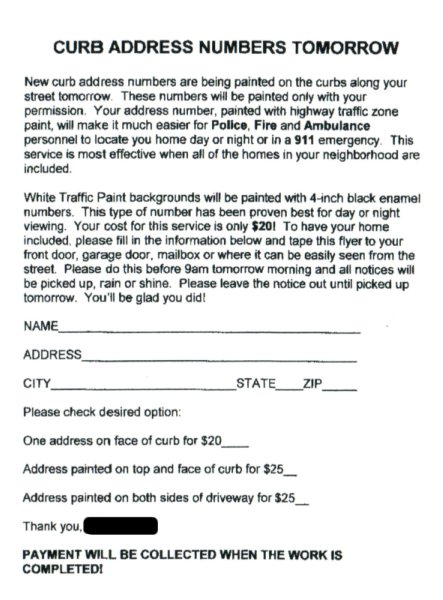
When I came home after work last Wednesday night I discovered a note taped to my front door. I’ve scanned it in and posted it to the right. Basically this guy is putting up notices that they’re going to be coming by the following day to repaint the numbers on the curb. I LOVE this idea!
It’s easy. Just fill out the flyer and hang it outside – they take care of everything else.
No risk. If they are going to paint your address and then come around asking for payment, you can always refuse if you think they did a bad job.
It’s cheap. His flyer was printed up on half a sheet of paper, so it probably cost him no more than $0.10 for two flyers – plus the half-inch of masking tape. The advertising costs are bare-bones. The materials amount to a few stencils and some spray paint.
It’s quick. I’m guessing with a proper stencil and some paint, you could whip out a curb address number in about a minute or so.
It’s a cash business. I didn’t see anything there about their tax ID number.
Slick advertising. They appeal to your sense of safety and security (helping the police, fire department, et cetera find you quickly) and your sense of community (suggesting it is more effective when the whole neighborhood joins in).
But, why stop there? I bet you could make even MORE money if you took this entire enterprise further:
Volume is key. Having as many houses on a single street is probably optimal. So, putting a little extra polish on these flyers could probably help a lot. Invest in better paper and use a paper cutter rather than scissors. Anything to help score a few more houses per street.
Price is key. I have to wonder how many people are paying for this service. What’s the optimal price point? I’m guessing for $10.00 you might be able to capture a lot more homes on a given street than the $20.00 they’re suggesting.
Look important. I’m always getting official looking junk mail – sometimes I even open it. I’d say use bond paper, a decent home printer or your local printer, print something up that implies you are affiliated with the city or county. Have an address, phone number, and website ready.
Location, location, location. If I were running such a business I would do a little homework. I would find a well kept neighborhood with a Home Owner’s Association – some area that probably has a vested interest in maintaining the upkeep around their homes.
Look really important. If I were doing this, my letterhead would say I was with the “Home Owner’s Association Maintenance Co-Operative of Contra Costa County.” I’d send out letters a week ahead saying that a person’s street has been scheduled for yearly curbside maintenance, that the HOAMCOCCC was going to through the following week to paint the numbers on an entire street a uniform color and returning the following day to collect payment.
Why in the world did I go to law school? What a colossal waste of time! I could probably more per hour stenciling sidewalks than I do as an attorney. I’m half tempted to give it a shot anyhow. :)
Anyhow, this just goes to show no matter how bad things are, someone has thought of a way to make money.
A company once told me someone had offered to build permanent disability calculators for their website in three months for $7,500. One said six months and $20,000. Recently, another suggested it would take them a year and $40,000. My response is usually some variation on “You’ve got to take that deal. You’re wasting your time talking to me.”
It’s no big secret that building a great product takes a lot of work. The important thing to remember is that just because something is easy-to-use, that doesn’t mean its easy-to-make. 1
Difficult-to-make iPhone
Let’s take the iPhone for example. Everyone will concede its an easy phone to use. However, it was released more than two years ago on 6/29/2007. 2 In that time the other players – BlackBerry, LG, Nokia, and Palm have all been trying to catch up. If this easy-to-use phone were easy-to-build everyone would have their own version.
Look, there’s no special magic to building a website like this. Really, anyone can do it. All you have to do is learn the calculations inside-and-out, deconstruct the math involved in the various calculations, learn some client and server side programming languages, learn a content management system, make it all work together, keep current on changes in the law, start all over again each time the law changes, and earn the respect of the workers’ compensation community. Once done, you’ll have your very own workers’ compensation calculator website!
To return to the lesson of the iPhone, building a touch screen phone that can play music and surf the web is totally doable. Doing it right is another matter entirely.