It's been a wild ride

Just over a month after oral argument the Court of Appeal has issued their ruling, reversing the en banc decisions of the Workers’ Compensation Appeals Board, annulled the award of permanent disability to Ms. Ogilvie, and remanding the case for further proceedings. 1

So, what does this new Ogilvie decision mean for us?

  1. The calculations from the en banc decisions of Ogilvie I/II are no longer valid.
  2. An injured worker can still rebut a scheduled rating in accordance with [Download not found] and [Download not found].
  3. An injured worker may rebut a scheduled rating in one of three ways:
    1. Demonstrating “a factual error in the application of a formula or the preparation of the schedule.”  (Ogilvie III, p10-11).  Given the examples provided, probably references proving a defect in the [Download not found] itself.
    2. Demonstrating impairments via [Download not found]-style analysis that “the employee will have a greater loss of future earnings than reflected in a rating because, due to the industrial injury, the employee is not amenable to rehabilitation.”  (Ogilvie III, p12).  However, the increased disability must not be “due to nonindustrial factors such as general economic conditions, illiteracy, proficiency to speak English, or an employee’s lack of education.”
    3. Demonstrating “the claimant’s disability has been aggravated by complications not considered within the sampling used to compute the adjustment factor.”  (Ogilvie III, p13).  This appears to be a two-step process of having to prove a complex injury and then proving that the sample for the adjustment factor didn’t account for such injuries or complications.

Download [Download not found] aka Ogilvie III right now!

  1. Photo courtesy of mpieracci []

What has two thumbs and loves to hear itself talk?  THIS GUY!!!
What has two thumbs and loves to hear itself talk? THIS GUY!!!

There was a great turn out this morning to the “How to Obtain an Accurate PD Rating with the AMA Guides” put on by the Workers’ Compensation Section of the State Bar.  We covered a lot of ground in just two hours, from the DEU perspective presented by Annalisa Faina and Barry Knight entitled “Anatomy of Rating”, to Mark Gearheart’s “Substantial Medical Evidence to Support a Permanent Disability Rating,” and my own presentation on “Litigating Ogilvie.”  There was a lively discussion on the state of Almaraz/Guzman, Blackledge, and Ogilvie. 12

Thanks to everyone who e-mailed me asking for the cases cited during our presentations.  I’ll be uploading them shortly.

Tonight is the “2010 Steve Jimenez Special Recognition Awards” honoring:

  • Lifetime Achievement: The Honorable Pamela Foust (Ret.)
  • Judge of the Year: The Honorable Jorja FrankHon. Jorja Frank
  • Applicant Attorney of the Year: Marc Marcus
  • Defense Attorney of the Year: Michael Marks

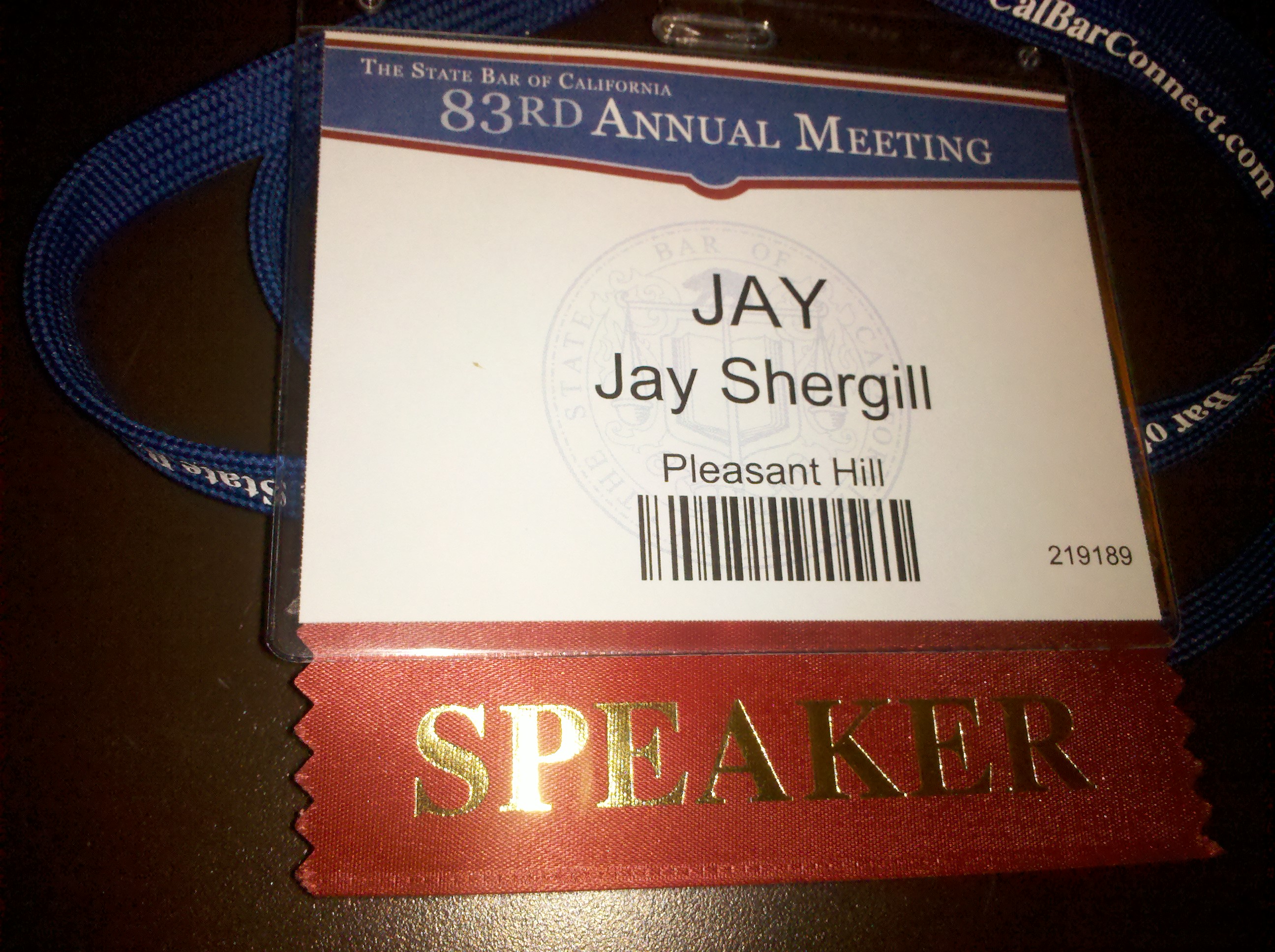
If you’re attending tonight, please stop me and say hello!  (I’ve got a name tag and everything)

  1. Lively as in “barely civil” []
  2. I’m kidding! []

This afternoon I am presenting at the Workers’ Compensation Section Spring Conference 2010 with a presentation entitled, “Calculating Ogilvie.”  Due to cases relevant to Ogilvie coming out as recently as ten days ago, I’m making the resources mentioned here for everyone to download (along with a rough outline of the presentation).

  1. Ogilvie Formula
    1. Ogilvie formula (longhand)
      1. Each of the steps in the Ogilvie formula explained
    2. Ogilvie formula (shorthand)
      1. Mathematical proof demonstrating a simplified Ogilvie formula
      2. Download the simplified Ogilvie mathematical proof as a PDF here
    3. Ogilvie formula (oversimplified)
      1. Learn how to perform an Ogilvie calculation in your head in 5 minutes (PDF download)
    4. Ogilvie formula (18 point rule)
      1. Read the Ogilvie “18 point rule”
      2. Download the Ogilvie “18 point rule” as a handy PDF
  2. Ogilvie Case Law
    1. Ogilvie v. WCAB I (en banc) 2/3/2009
    2. Ogilvie v. WCAB II (en banc) 9/3/2009
    3. Bowden v. Sunray Termite San Jose WCAB Panel Decision ADJ4536632
    4. Shini v. Pacific Coast Auto Body & Truck San Diego WCAB Panel Decision ADJ2079252 (1/25/2010)
    5. Ochoa v. UPS Ground Freight Order Denying and Report and Recommendation on Reconsideration ADJ1758338 (2/8/2010)
    6. Bertha Noriega Garcia v. Patrick L. Hinrichsen WCAB Panel Decision ADJ6721939 (3/1/2010)
  3. Litigating Ogilvie
    1. Argonaut Ins. Co. v. Ind. Acc. Com. (Montana) (1962) 57 Cal.2d 589
  4. Applicant Attorney Ogilvie Handbook
  5. Defense Attorney Ogilvie Handbook
  6. Appendix
    1. EDD Labor Market Information Division
    2. Cal. Labor Code § 4651 “Average annual earnings shall be taken as fifty-two times the average weekly earnings referred to in this chapter.”

Sample Ogilvie DFEC analysis brief, complete with citations, explanations, and exhibits

WCAB gives Ogilvie the green light

Apparently the defense attorney on Bowden v Sunray Termite wrote ex parte to the WCAB requesting the case be declared a significant panel decision. 1

Commissioner Miller’s letter (download below) notes Bowden was a “purely fact driven case” and “is not to be a statement of legal importance to the community.”  Commissioner Miller further points out Significant Panel decisions are citable panel decisions but not binding legal precedent. 2

[Download not found]

What does this mean to you?

Ogilvie has not been stayed, so sharpen your #2 pencils and work on your math skills.

  1. Photo courtesy of adamwilson []
  2. Even if the defense attorney’s request had been granted Ogilvie, as an en banc decision, would still take precedence over Bowden. []

This sign is ALSO not a stay on Ogilvie

I’m still getting e-mails suggesting that Bowden v. Sunray Termite is a WCAB Panel decision staying Ogilvie1  Thanks to some loyal readers, I now have a copy of this Panel decision:

[Download not found]
  1. Photo courtesy of loop_oh []

Just a red herring
Just a red herring

In a word, noOgilvie has not been stayed by the WCAB, Court of Appeals, or any other court at this time. 1

A defense attorney is circulating a letter suggesting that he got the Board to agree on Reconsideration to stay the application of Ogilvie on a case until the Supreme Court decides on the issue.

First, let me preface by saying the Board might theoretically decide to not apply the DFEC rebuttal analysis under Ogilvie for any number of reasons:

  • Perhaps the defense vocational expert witness was particularly persuasive
  • Perhaps the injured worker was a terrible witness
  • Perhaps the Board noted a particularly disproportionate effect of Ogilvie
  • Perhaps there were a lot of “motivational” issues for the injured worker
  • Perhaps the injury was less than 3 years old

Secondly, even if the Board found a way to decline to apply the DFEC rebuttal analysis under Ogilvie in one circumstance, this does not stay or overrule Ogilvie.  We would need to see something from either the Court of Appeals or another2 en banc Ogilvie decision from the WCAB.

Thirdly, while I have not seen the documentation to prove it, I have learned the Board declined to apply the DFEC rebuttal analysis under Ogilvie due to some technical issue not having much to do with the actual Ogilvie case.

So, to recap – Ogilvie has not been stayed.  If someone claims otherwise, ignore them until they produce the case.  And when you see it… send me a copy!

  1. Photo courtesy of jypsygen []
  2. Third!!! []

If you can use duct tape, you can perform an Ogilvie DFEC analysis in 5 minutes

An Ogilvie / DFEC analysis isn’t really difficult, especially when this website has a free Ogilvie / DFEC calculator.1 The problem comes when you have to prove all the math behind those calculations.  This involves “showing your work.”

The best way to “show your work” is to take the reader through each step of the Ogilvie analysis.  I’ve prepared a sample report (generated using a new service on this website) which provides a clear and easy to understand format for “showing your work.”

The steps are basically this:

  • Step 0:  2005 PDRS rating string
  • Step 1: Post-Injury Earnings of Applicant
  • Step 2: Post-Injury Earnings of Similarly Situated Employees
  • Step 3: Calculate Proportional Earnings Loss
  • Step 4: Calculate Individualized Rating to Loss Ratio
  • Step 5: Compare Individualized Rating to Loss Ratio to range of ratios for the FEC ranks

For those interested, here’s a more detailed explanation of each step in an Ogilvie / DFEC analysis.

When each step of the Ogilvie / DFEC analysis is stated clearly, the reader can see every assumption, step, and perform their own calculations to verify your conclusions.  As long as the parties agree on the numbers used in an Ogilvie / DFEC calculation, they should always arrive at the same result.

Setting forth every single step of your Ogilvie / DFEC analysis lets you to spend less time arguing about the impact of Ogilvie and more time trying to get the case settled.

  1. Photo courtesy of indigotimbre []

An early Christmas for PDRater users!

I plan to launch a brand new calculator service tomorrow.1

I think you’re really really going to like it.

Want a hint?

It’s going to help you with a case that rhymes with “Schmogilvie.”

  1. Photo courtesy of The School House []

Building the case for a DFEC rebuttal
Q: How do you build the case for a DFEC rebuttal? A: One step at a time.

There’s a lot of conflicting information about what Judge’s are requiring to making a finding of a DFEC rebuttal under Ogilvie v. City and County of S.F.1  The Board in Ogilvie II is explicit that all you need is post-injury earnings information for the injured worker and similarly situated employees and “simple mathematical calculations with that wage data” using a “non-complex formula.”2

Unfortunately, calling a process “simple” and “non-complex” doesn’t necessarily make it so.  Apparently some Judges are requiring some additional showing beyond wage data and “simple calculations.”

What are Judges in your area requiring?

  • Just wage data and calculations?3
  • Vocational testimony/evidence regarding earnings?
  • Proof of attempts to seek employment/motivation?
  • Something else?

Share your insight with an e-mail or comment.

  1. Photo courtesy of eliaspunch []
  2. Ogilvie II, p1-2. []
  3. Perhaps just a print-out from PDRater?  ;) []

Back to the drawing board

DOWNLOAD THE MATHEMATICAL PROOF AS A PDF!

A little while ago William S. Morris, an Applicant’s attorney, told me that the Ogilvie adjustment calculation could be further simplified. 1 He suggested the following2 :

  1. Earnings Loss34
    1. L = (PIESSE – PIEA) / PIESSE
  2. Individualized Proportional Earnings Loss
    1. = (WPI / L) / 100
  3. DFEC Adjustment Factor
    1. = ([1.81/a] * .1) + 1
    2. = ( (1.81 * .1)/a) + 1
    3. = (.181/a) + 1
    4. = 1 + (.181/a)
  4. Ogilvie DFEC Adjusted Rating
    1. = WPI * DFEC Adjustment Factor
    2. = WPI * (1 + (.181/a) )
    3. = WPI * (1 + (.181 / Individualized Proportional Earnings Loss) )
    4. = WPI * (1 + (.181 / ( (WPI / L) / 100) ) )
    5. = WPI * (1 + (18.1 / ( (WPI / L)  ) )
    6. = WPI * (1 + (18.1 * (L/WPI) ) )
    7. = WPI + (18.1 * L)
  5. Conclusion
    1. If the injured workers’ individualized proportional earnings loss is outside all of the FEC ranks, you may calculate the Ogilvie adjustment by adding (18.1*Earnings Loss) to the WPI.

The only flaw with the proofs offered by William and myself is that they are too exact.  The WCAB in Ogilvie never sets forth the exact process for performing the Ogilvie adjustment calculation – so the only official method involves rounding to different significant figures at different places.  Thus, a calculation performed in strict accordance with the WCAB in Ogilvie and through one of these mathematical proofs would differ very slightly.

What do you think? Leave a comment or drop me a line.

  1. Photo courtesy of Dahveed76 []
  2. I’m paraphrasing here []
  3. PIESSE = Post Injury Earnings of Similarly Situated Employees []
  4. PIEA = Post Injury Earnings of Applicant []