Last month I mentioned that this website had a record number of new visitors. I honestly thought that was an anomalous one day spike in traffic. Instead we’ve had a sustained increase in new visitors and people signing up to use the workers’ compensation calculators for free.
Since February 13, 20091 I’ve enjoyed posting about:
Ever since I relaunched this website I’ve had this idea in the back of my mind that getting to 500 users would be a big deal. There are literally hundreds of workers’ compensation professionals who rely on this website and its calculators to make their lives a little easier. This certainly feels like a big deal to me.
California Court of Appeals, Sixth Appellate District
Just when you thought things couldn’t get any crazier in workers’ compensation than Ogilvie, Almaraz/Guzman, Benson, and XyzzxSJO2. Yesterday I found out that on April 7, 2009 the case of Smith v. WCAB (California Youth Authority) is on calendar for oral argument. As with Almaraz/Guzman, Smith v. WCAB dealt with similar legal issues across two particular workers’ compensation cases. In case you missed it, here’s the court of appeal decision:
Smith involved an informal denial of medical treatment without a formal petition to terminate medical care under L.C. 4607, after an award of permanent disability. Eight years after Smith’s award, SCIF refused to authorize epidural injections. Smith’s attorney sought utilization review, Smith was reexamined by the AME who said the injections were necessary to relieve from the effects of the industrial injury. Although SCIF then authorized the injections without the need for a hearing, Smith’s attorney sought fees under L.C. 4607.
The WCJ denied Smith’s attorney’s petition for fess since there was no formal petition to terminated medical care. The WCAB denied reconsideration on the grounds that SCIF’s was not denying all medical treatment.
Amar is substantially similar to Smith, except that in Amar the workers’ compensation judge took the extra step of opining that SCIF’s denial of medical treatment was made in good faith, not unreasonable, and not improper.
However, the 2nd Appellate Court reversed the WCAB in Smith and Amar, stating in relevant part:
“We see no difference when a carrier informally denies some of the treatment that is a necessary part of medical care previously awarded. This is tantamount to a petition to deny medical care even though the carrier continues to provide treatment for some of applicant’s medical care.”
“Insurance carriers who fail to provide previously awarded medical care may not avoid attorney fees to successful applicants’ attorneys through the expedient of an informal denial, even when they do so in good faith.”
I would love to watch the oral argument on this case – but Los Angeles is a bit of a hike for me. 1 I am very very interested to see how this case shakes out.
I last watched oral argument on the Mt. Diablo Unified School District v. WCAB (Rollick) case back on 8/5/2008. It was particularly interesting for me since I was familiar with the applicant attorney, defense attorney, and facts of that case. If nothing else, its always fun to watch judges get snarky. [↩]
There are numerous workers’ compensation professionals who are incredibly unhappy with Ogilvie and Almaraz/Guzman. Vocational experts are unhappy with Ogilvie, and somewhat hopeful with Almaraz/Guzman. Impairment rating specialists are not happy with Ogilvie or Almaraz/Guzman. These people may be unhappy with these new cases, but at least they’re starting to adapt.
As Julius Young of WorkCompZone.com just reported, some people are dealing with Almaraz/Guzman by putting on “webinars.” Phil Walker and Christopher Brigham have each announced “webinars.” According to Walker’s promotional e-mail, he charges $2,000.00 to appear for a one day seminar – and now he’s giving it away for free.
People will try to convince you that Almaraz/Guzman is not the law or “just” a WCAB decision. Do not believe these people. Ogilvie and Almaraz/Guzman are both en banc cases.
En banc decisions of the Appeals Board are binding precedent on all Appeals Board panels and workers’
compensation judges. (Cal. Code Regs., tit. 8, § 10341; City of Long Beach v. Workers’ Comp. Appeals Bd. (Garcia) (2005) 126 Cal.App.4th 298, 313, fn. 5 [70 Cal.Comp.Cases 109, 120, fn. 5]; Gee v. Workers’ Comp. Appeals Bd. (2002) 96 Cal.App.4th 1418, 1425, fn. 6 [67 Cal.Comp.Cases 236, 239, fn. 6]; see also Gov. Code, § 11425.60(b).)
Ogilvie and Almaraz/Guzman are binding precedent on judges and the WCAB itself. Don’t believe the hype and don’t stick your head in the sand. 1 If you argue it is not the law or not binding precedent, you will lose. Yes, these cases may be appealed and may even be overturned.
I think it likely they will be appealled and highly unlikely they will be overturned.
I’ve just finished the COLA / SAWW future life pension rate calculator to determine what the future life pension rates are assuming a COLA / SAWW increase of 4.7% per year. If you’re interested in becoming a beta tester for this COLA / SAWW calculator for life pension increases, please drop me a line and ask for access. 2
Please keep in mind that this is not a life pension with SAWW / COLA increase commutation calculator. The actuarial math involved in performing that calculation is … intense.
As an interesting side note, this week I saw my very first DEU commutation of a life pension with COLA increase. Unlike the typical commutations everyone receives from the DEU, this commutation calculation was devoid of the actual methodology used. I was pretty disappointed to find this out.
No matter! Help beta test the new calculator by dropping me a line. After you’ve given it a whirl, let me know what you think.
A few months ago someone e-mailed me this video clip about an attorney struggling with EAMS. My thanks go out to Matthew Brueckner of the Law Office of Matthew Brueckner for putting this together.
Last week while Steve was at the Sacramento WCAB he heard about a recent case that held the COLA / SAWW adjustments and increases are calculated based upon the first January 1 following the date of injury. 12
This case involving SIF (the subsequent injuries fund) is from the San Jose WCAB. The name of the case is “XYZZXSJO2 v. Subsequent Injuries Benefits Trust Fund, ADJ 1510738, SJO 0251902”. The name of the Applicant was anonymized to protect their identity. 34
Thus far the conventional wisdom has been that the COLA/SAWW increases are calculated starting with the first January 1 after life pension gets paid out. This is a tremendous change in the COLA/SAWW calculation of life pension.
Assuming a 1/1/2003 injury at exactly 70% permanent partial disability, there would be 426.5 weeks of permanent disability paid after the permanent and stationary date before the life pension gets paid out. This equates to 8.2 years from the permanent and stationary date that has, thus far, not been taken into account with life pension calculations to date. To put this in perspective, if someone had an injury on 1/1/2003 and became P&S on that same date5 , the traditional method of calculating the life pension with COLA / SAWW increase would be too low by approximately 44%.
At the moment I’m finalizing a COLA / SAWW life pension calculator to determine what the future life pension rates are assuming a COLA / SAWW increase of 4.7% per year. If you’re interested in becoming a beta tester for this COLA / SAWW calculator for life pension increases, please drop me a line and ask for access.
Unfortunately, I don’t have a citation for the 4.7% COLA / SAWW increase, but I believe it to be the offiical average used by the DEU6 to calculate commutations of COLA / SAWW increases and adjustments. If you have an official citation or document from the DEU, please drop me a line so I can include that citation here!
I began maintaining a list of MPN providers about a year ago specifically because I find them so frustrating.1 (Explanation of the photo on the right2 ) Admittedly, a year ago I was an Applicant’s attorney, but that’s besides the point. Even as a workers’ compensation defense attorney and I’m still frustrated by MPN lists.
In order to find a treating physician with an MPN you need to have a conflagration of events. The right Medical Provider Network link to the right website for the right carrier with the right password.
According to the Division of Workers’ Compensation website, there are 1,334 official and approved Medical Provider Networks for California. Unfortunately, the Division of Workers’ Compensation list of MPN’s is almost completely worthless since it doesn’t include a website link or other useful information about these various Medical Provider Networks. The most useful part about the DWC’s list of MPN’s is that it will tell you whether or not a particular employer/self-insured/insurance company has an MPN. There is a lot of amount of duplication on the official MPN list. I would estimate there are really only about 500 or so unique Medical Provider Networks operating in California.
A “doc-in-the-box” is a derragotry phrase for a physician who is, for lack of a better term, in someone’s “pocket.” Doctor Who is a is a British sci-fi television show about someone called “The Doctor” who travels through time in a police box. The photo on the right with the caption is my attempt at humor. [↩]
I have no intention of manufacturing FEC Ranks 9 through 20 for the following reasons:
Maintaining Standards. The entire point of a rating schedule is to allow a standardized method for calculating disability and expressing those disability calculations. If I invented my own FEC Rank system beyond the scheduled 1-8 Ranks, I would essentially be creating my own rating calculation system. I’ve gone to considerable lengths to ensure that the rating strings produced by these permanent disability calculators are as standardized, recognizeable, and universal as possible.
FEC Ranks are Irrelevant. The FEC Rank system is a simplified method of applying DFEC adjustment factors. When you use the FEC Rank of a particular body part to adjust the standard using the charts on pages 2-6 and 2-7 of the 2005 PDRS (permanent disability rating schedule), what you’re really doing is essentially multiplying your standard disability against the FEC adjustment factor associated with the particular FEC Rank for the body part in question. An FEC Rank is only useful for telling you the appropriate FEC adjustment factor to apply to the standard disability. Thus, FEC Ranks are irrelevant and FEC adjustment factors are all important.
Arbitrary FEC Ranks. FEC Rank 1 has an FEC adjustment factor of “1.100”. However, using the OgilvieDFEC rebuttal formula, it is possible to end up with very low FEC adjustment factors. In extreme circumstances it would be possible to have a negative FEC adjustment factor. The only way to resolve this would be to have several possible negative FEC Ranks. Besides being somewhat silly, worrying about additional FEC Ranks2 misses the point. If you’re using the OgilvieDFEC rebuttal formula properly, the result will be a new FEC adjustment factor. If you already have the FEC adjustment factor, you have no need for the FEC Rank!
When I had discussed the impact of Ogilvie earlier, I had pointed out that in some cases the resulting formula will dictate that you use a different FEC Rank than the one indicated by the affected body part. In other cases you will need to use an entirely new FEC adjustment factor. In order to keep the 2005 disability calculator current I will eventually have to create a way for the user to override a body part’s standard FEC Rank and specify a new FEC Rank or their own FEC adjustment factor.
I’m not in any particular rush to develop this feature since Ogilvie seems to require three years of post-injury earnings. I doubt we’re going to see litigation begin in earnest over Ogilvie issues for another 18 to 24 months.
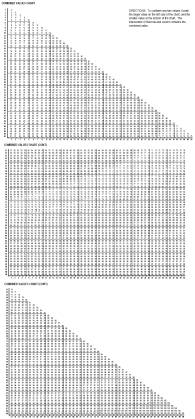
A few weeks ago I posted about the Multiple Disabilities Table for combining disabilities with injuries prior to 2005.
For injuries after 2005 we must turn to the 2005 Permanent Disability Rating Schedule. When combining disabilities for injuries after 2005 there are several possible alternatives. You can:
February has been a wacky month. And, on Friday February 13th the 400th user registered for this website. 1 Since the 300th registered user, quite a lot has happened:
Besides being Friday the 13th, today has a very special meaning for the truly nerdy. Unix is a computer operating system developed back in 1969. For those of you who remember DOS, that kind of what it looked like. The up-and-coming operating system Linux is based on Unix. The Unix epoch, the time from which it starts to count “up”, was on January 1, 1970. On 2/13/2009 at 6:31:30PM ET the Unix epoch reached the time “1234567890“.