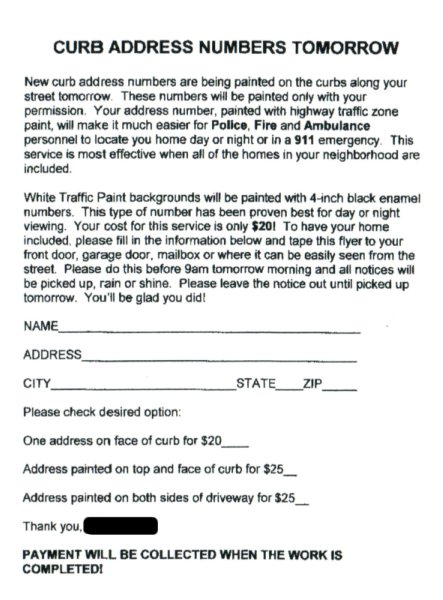
When I came home after work last Wednesday night I discovered a note taped to my front door. I’ve scanned it in and posted it to the right. Basically this guy is putting up notices that they’re going to be coming by the following day to repaint the numbers on the curb. I LOVE this idea!
It’s easy. Just fill out the flyer and hang it outside – they take care of everything else.
No risk. If they are going to paint your address and then come around asking for payment, you can always refuse if you think they did a bad job.
It’s cheap. His flyer was printed up on half a sheet of paper, so it probably cost him no more than $0.10 for two flyers – plus the half-inch of masking tape. The advertising costs are bare-bones. The materials amount to a few stencils and some spray paint.
It’s quick. I’m guessing with a proper stencil and some paint, you could whip out a curb address number in about a minute or so.
It’s a cash business. I didn’t see anything there about their tax ID number.
Slick advertising. They appeal to your sense of safety and security (helping the police, fire department, et cetera find you quickly) and your sense of community (suggesting it is more effective when the whole neighborhood joins in).
But, why stop there? I bet you could make even MORE money if you took this entire enterprise further:
Volume is key. Having as many houses on a single street is probably optimal. So, putting a little extra polish on these flyers could probably help a lot. Invest in better paper and use a paper cutter rather than scissors. Anything to help score a few more houses per street.
Price is key. I have to wonder how many people are paying for this service. What’s the optimal price point? I’m guessing for $10.00 you might be able to capture a lot more homes on a given street than the $20.00 they’re suggesting.
Look important. I’m always getting official looking junk mail – sometimes I even open it. I’d say use bond paper, a decent home printer or your local printer, print something up that implies you are affiliated with the city or county. Have an address, phone number, and website ready.
Location, location, location. If I were running such a business I would do a little homework. I would find a well kept neighborhood with a Home Owner’s Association – some area that probably has a vested interest in maintaining the upkeep around their homes.
Look really important. If I were doing this, my letterhead would say I was with the “Home Owner’s Association Maintenance Co-Operative of Contra Costa County.” I’d send out letters a week ahead saying that a person’s street has been scheduled for yearly curbside maintenance, that the HOAMCOCCC was going to through the following week to paint the numbers on an entire street a uniform color and returning the following day to collect payment.
Why in the world did I go to law school? What a colossal waste of time! I could probably more per hour stenciling sidewalks than I do as an attorney. I’m half tempted to give it a shot anyhow. :)
Anyhow, this just goes to show no matter how bad things are, someone has thought of a way to make money.
You may not want to hear this, but Ogilvie II is probably worse for Defendants than Ogilvie I. 1 Check out page 32:
if within five years of the date of injury it later becomes clear that the employee’s individualized proportional earnings loss is significantly higher or lower than anticipated, a party may seek to reopen the issue of permanent disability by challenging the originally used DFEC adjustment factor.
I think we can expect to see a petition to reopen on any case that settled prior to 2/3/2009. 2
A company once told me someone had offered to build permanent disability calculators for their website in three months for $7,500. One said six months and $20,000. Recently, another suggested it would take them a year and $40,000. My response is usually some variation on “You’ve got to take that deal. You’re wasting your time talking to me.”
It’s no big secret that building a great product takes a lot of work. The important thing to remember is that just because something is easy-to-use, that doesn’t mean its easy-to-make. 1
Difficult-to-make iPhone
Let’s take the iPhone for example. Everyone will concede its an easy phone to use. However, it was released more than two years ago on 6/29/2007. 2 In that time the other players – BlackBerry, LG, Nokia, and Palm have all been trying to catch up. If this easy-to-use phone were easy-to-build everyone would have their own version.
Look, there’s no special magic to building a website like this. Really, anyone can do it. All you have to do is learn the calculations inside-and-out, deconstruct the math involved in the various calculations, learn some client and server side programming languages, learn a content management system, make it all work together, keep current on changes in the law, start all over again each time the law changes, and earn the respect of the workers’ compensation community. Once done, you’ll have your very own workers’ compensation calculator website!
To return to the lesson of the iPhone, building a touch screen phone that can play music and surf the web is totally doable. Doing it right is another matter entirely.
As I mentioned previously, each of these cases is about 50 pages long, so there is clearly no substitute for reading them for yourself. However, here’s Ogilvie II and Almaraz/Guzman II in five sentences:1
The WCAB appears to have created a right to reopen a case for “individualized proportional earnings loss.”
Vocational testimony is not an appropriate way to dispute the DFEC portion of the 2005 Permanent Disability Rating Schedule.
(Bonus Dissent Summary: The lone dissent by Caplane says that vocational testimony should be considered proper rebuttal to an entire permanent disability rating.)
Almaraz/Guzman II:
The WCAB ruled that a doctor must issue reports within the “four corners” of the AMA Guides 5th Edition to comply with Labor Code Section 4660(c). 2
However, either party may obtain rebuttal evidence in the form of supplemental reports and depositions regarding the use of any other chapter, method, or table within the AMA Guides.
(Bonus Dissent Summary: The dissenting opinion from Brass, Caplane, and Moresi says they would affirm their decision in Almaraz/Guzman I.)
What do these cases mean for the practitioner?
The WCAB has created a new right to reopen for a higher than expected “individualized proportional earnings loss.”
Here, the phrase “four corners of the AMA Guides” just means the parties are restricted to the actual text of the AMA Guides and cannot use analogies and evidence from outside the AMA Guides. [↩]
And my dream is to do four walk through settlements at three different WCAB district offices in one single day.12
I’ve given this a lot of thought and I even have a plan as to how to get this done. If I ever got the chance to do four walk throughs at four Boards in one day, I’d do it like this:
Get up early, arrive at the Santa Rosa WCAB at 8:00 AM and attempt the first walk through
Head to San Francisco over the Golden Gate for the second walk through
In the afternoon, do the third walk-through in San Jose
Hit the road for Oakland and do the fourth walk through
I honestly don’t even know if this is possible. 3 There are a million things that could go wrong. I could hit traffic, I could be missing a page from a benefits printout, someone could change their mind about the settlement, a doctor could issue a supplemental report. I also know that I would need a LOT of things to go right. Here’s my tentative checklist:
Four walk through settlements ready to be approved at four different Boards (this is easily the toughest part)
Four claims examiners standing by on speed dial
One full calendar day
A fully charged GPS, two fully charged cell phones
A full tank of gas
$55.00 or so ($10 for bridge tolls, about $5 for photocopies, and easily another $40 for parking)
A bag of snacks (I’m probably not going to have time for lunch)
Call ahead to all of the Boards to make sure I can do a walk through that day
The good will and cooperation of the Board staff and my colleagues
Yesterday I received an e-mail from a beta tester, Jeff Duarte, who was having trouble with one of my calculators. He said that he didn’t really understand how to use a particular calculator. My response was:
The problem is not you, its me. :) If I designed my calculator better you wouldn’t have any questions.
Seriously – sorry Jeff, its my bad. My goal is to make these calculators so easy and intuitive to use that no workers’ compensation professional would have any trouble figuring out how to use them. If you don’t figure out how to use it just by looking at it, I designed it wrong. 1 Getting feedback is a very important and instructive process for me. It lets me figure out what works for people and what doesn’t.
The good news is that Jeff”s suggestions have given me an idea on how to make two calculators easier to use and for two entirely new features!