New Laptop
New Laptop

Since I reviewed available netbooks about two months back several new options have opened up.1 There’s the new Samsung NC11023 and a slew of new Acer One’s.

However, none of them can touch the 4GB Dell Mini 9 on sale right now for $199 with Ubuntu.

I know I had earlier said that 8GB was too small for my purposes. I had even suggested that I was more interested in some of the other available netbooks over the Dell for this reason.  However, I want to make my next computer a Dell, true to my word.

The reason I’m considering the 4GB version where I was dismissing the 8GB version before is the incredible price and the purposes to which such a laptop would be put.  In order to do about 98% of what I need with a laptop, I could easily use a netbook.  On any given day I use:

  • Firefox for web browsing
  • Thunderbird for e-mail
  • Pidgin for instant messaging
  • FileZilla for FTP transfers
  • Notepad++ for programming/text editing
  • OpenOffice for word processing, spreadsheets
  • TightVNC for remote access

All of these programs are open source software and available for Ubuntu4 and Windows.  So, in shopping for a laptop, I really don’t care about which operating system I use.  The 4GB Dell Mini 9 with Ubuntu could do all of these things – and for a $199 price tag.  Plus, with the Mini’s SD card slot, I could pop in an extra 16GB of memory for only $26.

  1. Photo courtesy of Ciccio Pizzettaro [↩]
  2. The Samsung NC110 is the successor to the NC10 [↩]
  3. A review of the NC110 I found helpful [↩]
  4. An easy-to-use Liniux installation. [↩]
AMA Guides 5th Ed.
AMA Guides 5th Ed.

Clearly, Almaraz/Guzman has been a boon to the U.S. Postal Service.  I’ve been receiving Almaraz/Guzman letters from Applicant attorneys on my files ever since the en banc decision came out.  These letters typically fall into one of three categories:

  1. Increased demands for settlement
  2. Demands for additional discovery per Almaraz/Guzman
  3. Letters to the PQME/AME requesting their opinions on impairment outside the AMA Guidelines to the Evaluation of Permanent Impairment, Fifth Edition

I’ve also heard of some doctors completely abandoning the AMA Guidelines to the Evaluation of Permanent Impairment, Fifth Edition, in favor of just analogizing impairment.  This is not what was intended by the en banc panel in WCAB in Almaraz/Guzman.

Here’s what Almaraz/Guzman means for workers’ compensation practitioners:

So, remember:

  1. Whether you agree with the AMA Guides or the 2005 PDRS they’re still the law of the land and must be addressed.
  2. Whether you agree with Almaraz/Guzman, it’s still good law and must be addressed.
  3. Almaraz/Guzman does not absolve a doctor from the responsibility to generate a medical report which addresses the AMA Guides and constitutes substantial medical evidence.

When Eggs Go Bad
When Eggs Go Bad

This weekend I learned that there had been a recall of organic brown eggs produced at en Dulk Poultry Farms in Ripon, California and distributed through Safeway, Pak n’ Save, and CostCo. 1  Although no illnesses have been reported, they are initiating this recall admist concerns about Salmonella.

Here’s how to check if you have these recalled eggs:

  • You have “Kirkland Organic Brown Eggs” from CostCo in the 18-count cartons.  It will have either of the expiration and plant codes:
    • April 1 062, 35 P1776
    • April 8 069, 35 P1776
  • You have “O Organic Grade A Large Brown Eggs” from Safeway and Pack n’ Save in the 12-count cartons with the expiration and plant code:
    • April 1 062, 35 P1776

I’m glad I checked:  I had the 12 count container of recalled eggs from Safeway in my fridge.  More details about the egg recall can be found in the article from the San Jose Mercury News.

  1. When Eggs Go Bad courtesy of TimOve. [↩]

SPOILER warning: This post discusses every big reveal from series finale

Battlestar Galactica: The Finale

If you’re a fan of Battlestar Galactica like myself, you may have watched the finale on Friday night and thought, “What the hell?”  This show has introduced so much character development, conflict, and drama over four years that it is honestly difficult to tell whether I’m disappointed the series is ending or disappointed with the series’ ending.1 They wrapped up most of the big questions and left a lot unanswered.  Without further ado, I present you with the answers to all the outstanding questions gleaned from the post-finale press conference:

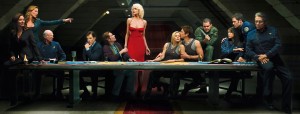
  1. What’s the deal with the Battlestar Galactica “Final Supper” picture?
    Red Herring
    Red Herringe?

    • Its an unintentional red herring. 2  basically has nothing to do with the show’s plot.  It was a photo op someone thought would be cool.3  The writers had nothing to do with the photo setup, so don’t read anything into it.
  2. What’s the deal with the “Cylon god”?
    • We don’t know.  The “Cylon god” is not necessarily the same “god” referred to by the imaginary Baltar and Six.  We probably won’t know for sure about the “Cylon god” until “Battlestar Galactica: The Plan” comes out in Fall 2009.
  3. What’s the deal with imaginary Baltar and Six and the real Baltar and Caprica Six?
    • The imaginary Baltar and Six are agents of “god” that apparently only manifest to the real Baltar and Caprica Six.  They are neither good nor bad, neither angels nor demons.  The “god” the imaginary Baltar and Caprica Six serve is something akin to the collective unconscious underlying the universe.  Their sole mission was to ensure the real Baltar and Caprica Six survive to deliver Hera to the CIC on the Galactica.  The real Baltar and Caprica Six come to believe in the god described by their imaginary counterparts.  This belief enables Baltar (a true cynic) to deliver his speach to Cavil and almost broker peace between the Cylons and humans and break the cycle of violence.
  4. What’s the deal with the opera house dreams?
    • Four people (9Sharon “Athena” Agathon – a Cylon 8 model, President Laura Roslin, Dr. Gaius Baltar, and Caprica Six)) shared the opera house dream.  This dream was meant to guide each of these people to the CIC on the Galactica at the end of the confrontation between the humans and Cylons.
  5. What’s the deal with Kara Thrace/Starbuck?
    • Who the frak knows.  While we don’t know how she was brought back to life, we do know why she was brought back.  We also have no idea where she went or how she just disappeared.  She was brought back from the dead for the purpose of entering the numeric equivalent of “All Along the Watchtower” into the FTL drive.  Starbuck, her father, and Hera all tapped into something eternal and fundamental underlying the entire universe in order to hear/play this song.
  6. What’s the deal with Daniel? Was Daniel the father of Kara Thrace/Starbuck?
    • Red Herring
      Red Herring

      He was an unintentional red herring.  He was meant to be a “Cain and Abel” back story for Cavil to show he was a right bastard – nothing more.  While there are certain pieces which support this theory, he was never meant to be Starbuck’s dad.  The “Daniel” model Cylon would have been permanently destroyed long before Starbuck was ever born.

  7. What happened to the Cylons in the base near the black hole?
    • After Racetrack’s Viper was knocked around, it accidentally nuked the Cylon baseship.  After the battle and after the Galactica jumped away, it lost its stable orbit at the edge of the black hole and was pulled in.
  8. What’s the deal with the various prophecies, the mandala/nebula/nova in Starbuck’s drawings, and “All Along the Watchtower”?
    • “Everything has happened before and will happen again.”  The cycle of humans, humans building Cylons, Cylons evolving, human-Cylon violence, has occurred for thousands of years and will occur again.  During these cycles certain people (Starbuck, Starbuck’s father, prophets, those who see the opera house dreams, etc) all tap into the collective unconscious underlying the universe.  This allows Starbuck’s father to compose “All Along the Watchtower,” Hera to paint the musical notes for it, the song to be the key to unlock the final five, and the song to be the numerical equivalent of the way to our Earth.  150,000 years after everything in this series, humankind has again evolved to the point of embracing technology.  This would allow the new BSG series to serve as a background and origin story for the original BSG series.

Most of this information is from the post-Battlestar Galactica finale interview.  I’ve tried to make it as intelligible as I can.

Do you disagree with my descriptions above?  Do you have another BSG question you need resolved?  Let me know in the comments!

  1. Photo by way of “diverse distinctive dave’s” blog [↩]
  2. Photo courtesy of stridli.  Editing, all me! [↩]
  3. And, they were right. [↩]

Your request for hearing has been DENIED
Request for hearing DENIED

Tuesday I tried to submit settlement documents for a walk-through in Oakland. 1 I had prepared the document cover sheet, minutes of hearing, and had everything ready to go.  As per procedure, I left the packet with the court clerk and came back about half an hour later.

When I returned the settlement documents were still on the counter, but without any indication of which judge I would be seeking approval from.  I was told that the documents had already been signed by the day’s walk-through judge.

That’s when the fun started.

The computer told the clerk that the original documents in front of us had the judge’s signature and that the judge had the file.  The documents clearly did not have the judge’s signature.  However, since EAMS believed the documents were already approved, it felt (?) I  shouldn’t be given the opportunity to walk the documents through.  Even more interestingly, the EAMS was telling us that the documents had been approved that very afternoon.

Since I had stamped the documents in, the clerk did not want to return them to me so that I could ask the judge if he had signed the settlement.  Mind you, the judge would have had to sign the documents (in invisible ink) in the half hour between the time I dropped off the documents and came back to pick them up.  Eventually I was allowed to take the documents with me to ask the judge if he had signed them.

Once before the walk-through judge, I explained that I had no board file because EAMS believed he already had the file and had approved the documents I was handing him.  Puzzled, the judge went to investigate whether he had approved the documents that did not have his signature.  He returned a few minutes later saying that he did not have the file, he did not recall signing the documents, and that he did not recall signing any documents for myself or the Applicant’s attorney involved.  EAMS was adamant that he had signed those documents.

Thankfully everyone in the hearing room was good-natured about the entire thing.  The funniest part about the entire situation is that the court clerk, myself, and the judge were made to doubt our own recollection, the documentary evidence in front of us, and sanity because EAMS said so.

If you haven’t seen this already, you should really see this incredibly funny EAMS video.

  1. Photo courtesy of racatumba. [↩]

Indy 500
Indy 500

Wow!  500 registered users!

Last month I mentioned that this website had a record number of new visitors.  I honestly thought that was an anomalous one day spike in traffic.  Instead we’ve had a sustained increase in new visitors and people signing up to use the workers’ compensation calculators for free.

Since February 13, 20091 I’ve enjoyed posting about:

Ever since I relaunched this website I’ve had this idea in the back of my mind that getting to 500 users would be a big deal.  There are literally hundreds of workers’ compensation professionals who rely on this website and its calculators to make their lives a little easier.  This certainly feels like a big deal to me.

  1. When the 400th user registered. [↩]
  2. I am keeping this calculator in beta testing until I get a little more feedback.  If you want to try it out, just drop me a line! [↩]

California Court of Appeals, Sixth Appellate District

Just when you thought things couldn’t get any crazier in workers’ compensation than Ogilvie, Almaraz/Guzman, Benson, and XyzzxSJO2.  Yesterday I found out that on April 7, 2009 the case of Smith v. WCAB (California Youth Authority) is on calendar for oral argument.  As with Almaraz/Guzman, Smith v. WCAB dealt with similar legal issues across two particular workers’ compensation cases.  In case you missed it, here’s the court of appeal decision:

Smith involved an informal denial of medical treatment without a formal petition to terminate medical care under L.C. 4607, after an award of permanent disability. Eight years after Smith’s  award, SCIF refused to authorize epidural injections.  Smith’s attorney sought utilization review, Smith was reexamined by the AME who said the injections were necessary to relieve from the effects of the industrial injury.  Although SCIF then authorized the injections without the need for a hearing, Smith’s attorney sought fees under L.C. 4607.

The WCJ denied Smith’s attorney’s petition for fess since there was no formal petition to terminated medical care.  The WCAB denied reconsideration on the grounds that SCIF’s was not denying all medical treatment.

Amar is substantially similar to Smith, except that in Amar the workers’ compensation judge took the extra step of opining that SCIF’s denial of medical treatment was made in good faith, not unreasonable, and not improper.

However, the 2nd Appellate Court reversed the WCAB in Smith and Amar, stating in relevant part:

“We see no difference when a carrier informally denies some of the treatment that is a necessary part of medical care previously awarded. This is tantamount to a petition to deny medical care even though the carrier continues to provide treatment for some of applicant’s medical care.”

“Insurance carriers who fail to provide previously awarded medical care may not avoid attorney fees to successful applicants’ attorneys through the expedient of an informal denial, even when they do so in good faith.”

I would love to watch the oral argument on this case – but Los Angeles is a bit of a hike for me. 1  I am very very interested to see how this case shakes out.

  1. I last watched oral argument on the Mt. Diablo Unified School District v. WCAB (Rollick) case back on 8/5/2008.  It was particularly interesting for me since I was familiar with the applicant attorney, defense attorney, and facts of that case.  If nothing else, its always fun to watch judges get snarky. [↩]

Glasses, online
Glasses, online!

Is pupillary distance is important?

Does pupillary distance matter?

Yes! Pupillary distance is the distance, in millimeters, between the center of your eyes.  When your eyeglass professional is building your glasses, they will need to make sure the “sweet spot” for each lens is directly in front of each eye.  They do this using your pupillary distance.

Its possible to have a different pupillary distance for each eye if your eyes are not the same exact distance from the center of your face.  Don’t feel bad – your mom still loves you!

When you go into a brick and mortar eyeglass store, they measure your pupillary distance for you.  If you’re buying glasses online, you can either measure your pupillary distance yourself or you can ask your eye doctor to measure it for you.  If you’re buying glasses online, don’t cheap out – get your eye doctor to measure your pupillary distance for you.  You can do it yourself – but why leave something this important up to chance?  If you insist on doing it yourself, you just need a mirror and a metric ruler and measure the distance between the center of your two pupils.

Now that I’ve answered the burning question about pupillary distance:

Glasses, online
Glasses, online!

Last week I posted a Goggles4U.com review. 1 My review was favorable despite having received glasses that didn’t really work for me.  It just so happens, according to my eye doctor, that some people are more sensitive to the “Base Curvature.”  I happen to be one of those people and there’s no way either I or Goggles4U could have known that.  The bottom line is that I received glasses with the exact prescription I specified- you can’t ask more than that.

After trying out this pair of glasses for a week I notified Goggles4U customer service that I was too sensitive to the “Base Curvature.”  They responded immediately and gave me a code to order a new pair.  I placed the order on 2/27/2009, sent them an e-mail specifying a comfortable range for the Base Curvature.  The new glasses arrived on 3/7/2009.

These new glasses, with transition/polychromatic lenses, are great. I haven’t had any problems with them at all.  I will still take them back to my eye doctor to confirm, because I think any review would be incomplete without an independent confirmation from a medical professional.

In end sum, I would recommend Goggles4U without reservation.  Check out my prior review (now updated!) for the complete review and a Goggles4U coupon.

  1. Photo courtesy of Morningstar Lee [↩]

Get your head out of the sand!

UPDATE 9/3/2009:  Download the new en banc Ogilvie II and Almaraz/Guzman II decisions here!

There are numerous workers’ compensation professionals who are incredibly unhappy with Ogilvie and Almaraz/Guzman.  Vocational experts are unhappy with Ogilvie, and somewhat hopeful with Almaraz/Guzman.  Impairment rating specialists are not happy with Ogilvie or Almaraz/Guzman.  These people may be unhappy with these new cases, but at least they’re starting to adapt.

As Julius Young of WorkCompZone.com just reported, some people are dealing with Almaraz/Guzman by putting on “webinars.”  Phil Walker and Christopher Brigham have each announced “webinars.”  According to Walker’s promotional e-mail, he charges $2,000.00 to appear for a one day seminar – and now he’s giving it away for free.

People will try to convince you that Almaraz/Guzman is not the law or “just” a WCAB decision.  Do not believe these people.  Ogilvie and Almaraz/Guzman are both en banc cases.

En banc decisions of the Appeals Board are binding precedent on all Appeals Board panels and workers’
compensation judges. (Cal. Code Regs., tit. 8, § 10341; City of Long Beach v. Workers’ Comp. Appeals Bd. (Garcia) (2005) 126 Cal.App.4th 298, 313, fn. 5 [70 Cal.Comp.Cases 109, 120, fn. 5]; Gee v. Workers’ Comp. Appeals Bd. (2002) 96 Cal.App.4th 1418, 1425, fn. 6 [67 Cal.Comp.Cases 236, 239, fn. 6]; see also Gov. Code, § 11425.60(b).)

Ogilvie and Almaraz/Guzman are binding precedent on judges and the WCAB itself.  Don’t believe the hype and don’t stick your head in the sand. 1 If you argue it is not the law or not binding precedent, you will lose.  Yes, these cases may be appealed and may even be overturned.

I think it likely they will be appealled and highly unlikely they will be overturned.

  1. Photo courtesy of blakeimeson [↩]