Workers Compensation Calculator
Workers' Compensation Calculator

I had an interesting e-mail exchange with a friend (and fellow workers’ compensation professional) the other day.1

We were discussing the impacts of Ogilvie on 2005 schedule ratings.  He had asked me whether I intended to update the 2005 permanent disability rating calculator to include FEC Ranks after the scheduled 8.  I believe he had suggested FEC Ranks 9 through 20.

I have no intention of manufacturing FEC Ranks 9 through 20 for the following reasons:

  • Maintaining Standards. The entire point of a rating schedule is to allow a standardized method for calculating disability and expressing those disability calculations.   If I invented my own FEC Rank system beyond the scheduled 1-8 Ranks, I would essentially be creating my own rating calculation system.  I’ve gone to considerable lengths to ensure that the rating strings produced by these permanent disability calculators are as standardized, recognizeable, and universal as possible.
  • FEC Ranks are Irrelevant. The FEC Rank system is a simplified method of applying DFEC adjustment factors.  When you use the FEC Rank of a particular body part to adjust the standard using the charts on pages 2-6 and 2-7 of the 2005 PDRS (permanent disability rating schedule), what you’re really doing is essentially multiplying your standard disability against the FEC adjustment factor associated with the particular FEC Rank for the body part in question.  An FEC Rank is only useful for telling you the appropriate FEC adjustment factor to apply to the standard disability.  Thus, FEC Ranks are irrelevant and FEC adjustment factors are all important.
  • Arbitrary FEC Ranks. FEC Rank 1 has an FEC adjustment factor of “1.100”.  However, using the Ogilvie DFEC rebuttal formula, it is possible to end up with very low FEC adjustment factors.  In extreme circumstances it would be possible to have a negative FEC adjustment factor.  The only way to resolve this would be to have several possible negative FEC Ranks.  Besides being somewhat silly, worrying about additional FEC Ranks2 misses the point.  If you’re using the Ogilvie DFEC rebuttal formula properly, the result will be a new FEC adjustment factor.  If you already have the FEC adjustment factor, you have no need for the FEC Rank!

When I had discussed the impact of Ogilvie earlier, I had pointed out that in some cases the resulting formula will dictate that you use a different FEC Rank than the one indicated by the affected body part.  In other cases you will need to use an entirely new FEC adjustment factor.  In order to keep the 2005 disability calculator current I will eventually have to create a way for the user to override a body part’s standard FEC Rank and specify a new FEC Rank or their own FEC adjustment factor.

I’m not in any particular rush to develop this feature since Ogilvie seems to require three years of post-injury earnings.  I doubt we’re going to see litigation begin in earnest over Ogilvie issues for another 18 to 24 months.

  1. Photo courtesy of Street Fly JZ [↩]
  2. Both higher and lower than the normal 8 [↩]

A Road Warrior is prepared for bad weather

Here’s what my fortune cookie on Saturday night said:

My fortune

I rather enjoy putting my imaginative skills to work with these little doodles.  ANYhow, now that that’s out of the way…

The last few days I’ve had several appearances in less than ideal weather.  With no further ado, my Road Warrior Checklist for traveling in bad weather:

  • Timing. My rule of thumb is to leave 15 minutes earlier for every hour of a planned trip in bad weather.
  • Speed. Speeding will make you feel good about your pace, but will never save you a significant amount of time.
  • Pick the correct lane. There are a lot of factors involved in choosing the correct traveling lane.  Driving in the path of other vehicles ensures your tires are touching more of the road and less of the water.  Stay out of the fast lane if possible.  Get out of other people’s way when they want to pass.
  • Stay in the correct lane. Try not to change lanes.   There is a lot more water between lanes and more chances to hydroplane.
  • No Cruise Control! There is an urban myth that if your car is on cruise control and you start to hydroplane your vehicle will accelerate to make up for the loss in traction.  The reason the highway patrol recommends against the use of cruise control in wet weather is that you only have moments to react to hydroplaning by reducing speed and maintaining control of your vehicle.  Cruise control in these situations will deprive you of a few moments of a potential speed decrease (where you would take your foot off the gas) by maintaining your current speed.
  • Following distance. Other people are going to be driving like maniacs.  Always make sure you have plenty of following distance.
  • Brakes. If your brakes are squeaking, they’re already in bad shape.  Get them checked out and replaced regularly.
  • Tires. Get your tires rotated regularly, make sure they have plenty of tread, and make sure they are properly inflated.  Remember the penny test: if you stick a penny into the tread and can see the top of Lincoln’s head you need to replace your tires.
  • Windshield wiper blades. Worn blades will just smudge.  Just plan on replacing your windshield blades every year.  Don’t forget your rear windshield wipers!

Prior “Road Warrior Checklists”

Refresh for updates
Refresh for updates

In no particular order:1

  • I often refer to myself as a Workers’ Compensation nerd.  The other day I realized that would be a GREAT website name!  Unfortunately, WCNerd.com is already taken by “white collar nerd.”  Bummer, no?  What a great e-mail address that would have been, too!
  • With well over a 100 posts and counting I thought it was time to include a “tag cloud.”  Its on the bottom of the right sidebar of this website.  Its basically a grouping of the common words I use to tag various posts.  The more common a word is the larger it appears.  The top contenders are pretty telling
  • To help with the website navigation and use of the “tag cloud” I’ve started being more liberal with how I tag my various posts.  Its actually kinda fun.
  • I’m  using a new e-mail contact form.  I was using “Contact Form 7,” which has a truly impressive feature list. While effective, I didn’t much care for this plugin because of its complexity.  What I really wanted was a quick and easy way for website visitors to send me e-mail.  Recently I found “Tiny Contact Form” by Tom Braider to be exactly what I needed.  It is small, simple to configure, and easy to include.  I’m actually using a modified version of the really fantastic “Tiny Contact Form” plugin.  I’m rather proud of my modification on this plugin and even sent Tom Braider my changes which he ended up incorporating into the next version!
  • Google recently swallowed up Feedburner.  I was using Feedburner to manage the RSS feeds for this website.  The only problem was that it was causing all kinds of problems.  My RSS reader wasn’t picking up the new posts from my own blog!  So, I scrapped the Feedburner management of my RSS feed and went back to the native WordPress support for RSS (which is pretty damn good).
  1. Photo courtesy of RandomChu [↩]

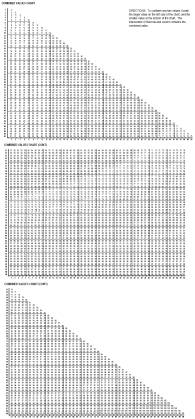
Combined Values Chart for the 2005 PDRS

A few weeks ago I posted about the Multiple Disabilities Table for combining disabilities with injuries prior to 2005.

For injuries after 2005 we must turn to the 2005 Permanent Disability Rating Schedule.  When combining disabilities for injuries after 2005 there are several possible alternatives.  You can:

  1. In case you’re wondering, the chart on the right is a super-condensed version of the Combined Values Chart on pages 8-2 through 8-4. [↩]
  2. Honestly, I don’t recommend this.  It wasn’t fun. [↩]

1955 Packard 400
1955 Packard 400

February has been a wacky month.  And, on Friday February 13th the 400th user registered for this website. 1 Since the 300th registered user, quite a lot has happened:

  1. Photo courtesy of atxbill [↩]
  2. Trust me, its easier than it sounds… [↩]
  3. I have several more of these planned [↩]

Wordpress Upgrade
Wordpress Upgrade

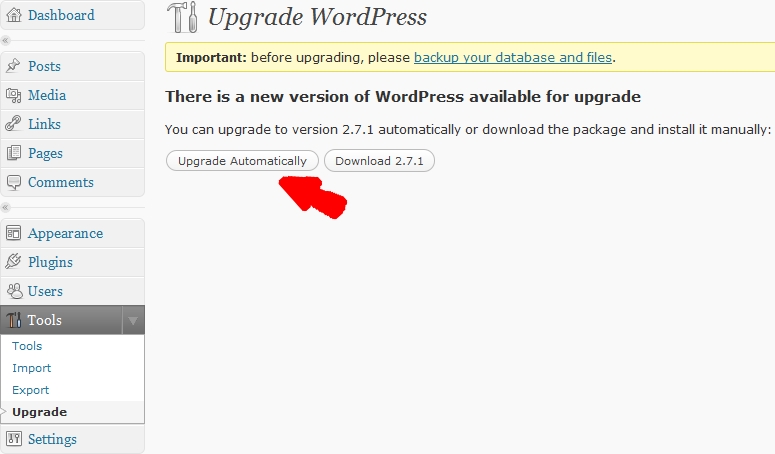
I upgraded to WordPress v2.7.1 as soon as it came out (after testing on another website, of course).  I can honestly say WordPress is the only software I use that I actually look forward to upgrading.

Since version 2.7 RC 1, upgrading to the next version of WordPress has been this easy:

How to Upgrade WordPress

You click “Upgrade Automatically” and wait about 5 seconds.

You’re done.

Not entirely off topic: a friend of mine asked me yesterday about the best way to put up a new website.  She had thought about using Yahoo Site Builder or some such.  Yahoo and its like are great at building free, quick, and ugly websites.  If you’re going to publish on the internets, why not just opt for something just as easy and that has hundreds, if not thousands of possible totally free themes to choose from?  I say, go with WordPress.

I used to code sites by hand – that’s a chump’s game.  Just install WordPress and call it a day.

So Many Calclators, So Little Time

After some additional testing and feedback, I have launched the Ogilvie Calculator aka DFEC Calculator aka Diminished Future Earning Capacity Calculator.1

To all of my friendly beta-testers:  Thank you!

So, what are you waiting for?  Signing up for this website is totally free and takes 30 seconds.  Log in, give it a whirl and let me know what you think.

  1. Photo courtesy of teclasorg. [↩]

California Court of Appeals, First Appellate District

The First Appellate District of the Court of Appeal of the State of California has affirmed the Workers’ Compensation Appeals Board in Benson v. WCAB and the Permanente Medical Group, affirmed (2/10/2009).  The Court of Appeals held, in relevant part, that “[t]he Wilkinson doctrine is inconsistent with the apportionment reforms enacted by Senate Bill No. 899.”

The basic upshot is that barring “limited circumstances” each distinct industrial injury will require its own Award.

First Ogilvie and Almaraz/Guzman, now Benson?  Its been an exciting two weeks to be a Workers’ Compensation attorney.

Office of the Clerk
Office of the Clerk

A modern hacker #1
A modern hacker #1

I launched the Ogilvie DFEC Rebuttal Calculator on Saturday morning to a select group of beta-testers. 1 When I upgraded a person’s access to the website they had no problem seeing the workers’ compensation calculator.

Unfortunately, not one of them was able to actually use the thing.  Last night my wife suggests the problem might be, “maybe they are using a different version or its not refreshed or something”?

And you know what?  She was right.  My wife, the hacker.2

I’ve written several protections into these calculators to insulate my users from having to deal with problems or bugs from newly installed code.  I would much rather a user sees nothing than get a wrong answer.  And nothing is exactly what my users saw.  I had remembered to allow my beta testers to see the Ogilvie DFEC Rebuttal Calculator – but forgot to give them access to calculator.

So, the beta-test period will continue for another day or two while I await feedback from my users.

If you’d like to see what the Ogilvie DFEC Rebuttal Calculator looks like or want to try to use it, just sign up for free and shoot me an e-mail asking for access.

  1. By “select group” I mean anyone who asked me if they could help. [↩]
  2. Photo courtesy of gutter. [↩]

How to build a calculator: Its like smashing a calculator - only in reverse
How to build a calculator: It's like smashing a calculator - only in reverse

I’m going to delay the launch of the Ogilvie DFEC rebuttal calculator for a day or two. 1  I believe it works just fine, but I would like to test it a little more.  This said, I will grant anyone who is interested access to this calculator.

Why the delay?  Well…

The interesting thing about taking apart a set of calculations is that you find all sorts of “hidden steps” to the calculation.  The majority in Ogilvie does a respectible job of going through the steps of this new formula and even gives several examples.

When performing most calculations one will need to round numbers at some point.  However, rounding almost invariably takes place at the very end.  In the case of the Ogilvie calculations, it appears that the WCAB rounds various figures throughout the calculation.

Even though the DFEC rebuttal calculator was giving correct answers, the fourth or fifth decimal places on some intermediary figures occasionally did not coming out right.  It took me a little while to track down all the spots where the WCAB was implicitly rounding their figures (and to what decimal place!).

I am fairly confident the calculator will work without a hitch, but I’m going to test it a little more before I make it available to the public.  If you’re interested in testing this Ogilvie DFEC rebuttal calculator, please drop me a line and let me know.

If you’re not a registered user for this website, its free to sign up and free to use all the workers’ compensation calculators.  Seriously, free as in free!

  1. Photo courtesy of mhuang [↩]