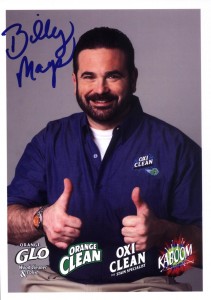
Billy Mays for President

Obama’s campaign purchased several primetime television slots on the major networks for a half hour broadcast.  Those in the Obama campaign have called this program his, “closing argument,” and critics have called it an “infomercial.”1

Summary

Obama hit all the high points with this program:

  • “The American Dream”
  • Eight years of failed policy
  • “Middle class”

He reiterated his campaign pitches:

  • Strengthening the economy
  • Green technologies
  • Tax cuts for 90% of Americans
  • Affordable health care
  • Affordable higher education

No political speech this year would be complete without your own “Joe the Plumber” story.

  • Rebecca’s husband who works with a torn ACL because his family cannot afford for him to take time off.
  • Larry and Juanita Stuart a couple who are still working at 72 even after taking out a reverse mortgage because their planned retirement cannot help with their medical costs.
  • A special needs schoolteacher working two jobs.
  • Melinda and Mark, who are third generation Ford factory workers who don’t know what to do now that she lost her job and he only has work every other week.

Review

A long time ago I had an internship with the local cable access company.  I took a lot of courses in video editing, lighting, and camera work.  I even worked one of the floor cameras on a live broadcast once.  Some of the course I took involved planning out how to produce a television program.

The production costs on this program must have been astronomical.  Even if you didn’t care for the content, it was beautifully edited and scored.  During last night’s “Joe the Plumber” stories you could hear a low dreary soundtrack in the background.  When Obama was talking the music would swell as he built his arguments.

If this was an infomercial, its was best goddamn infomercial I’ve ever seen in my life.  We should all thank our lucky stars Billy Mays2 doesn’t have this kind a production crew.

The ancient Greek philosopher, Aristotle, believed that persuasive arguments could be broken down into three categories: ethos, pathos, and logos.3  Ethos is based on credibility, pathos on emotion, and logos on logic or reason.

As a piece of persuasive rhetoric4 that program had it all.  The endorsements from various public figures lent their ethos to Obama.  The “Joe the Plumber” pieces about American families certainly provided enough ethos.  And, Obama himself laid out his strategic vision for fixing the problems facing those same families.

Obama’s program reminded me of one of my favorite quotes from Benjamin Franklin.  Franklin enjoyed listening to sermons. Franklin wrote in his autobiography about one such sermon from a Mr. Whitfield.

I happened soon after to attend one of his sermons, in the course of which I perceived he intended to finish with a collection, and I silently resolved he should get nothing from me, I had in my pocket a handful of copper money, three or four silver dollars, and five pistoles in gold. As he proceeded I began to soften, and concluded to give the coppers. Another stroke of his oratory made me asham’d of that, and determin’d me to give the silver; and he finish’d so admirably, that I empty’d my pocket wholly into the collector’s dish, gold and all.

I imagine Benjamin Franklin would have been willing to empty his pocket all over again for Obama.

Update: If you want to watch the entire broadcast (minus the live 3-4 minute segment at the end), here’s the video:

  1. Photo from MacResource forums.  If you own this picture, please let me know so I can attribute you. []
  2. Of the OxyClean fame. []
  3. Mom, Dad, that dual major in Philosophy and Rhetoric and Communications finally came in handy!!! []
  4. Rhetoric in and of itself is not bad – its just a means of communication. []

Not a new calculator

Last week, at the request of a paid subscriber, I added a new permanent disability rating calculator feature.1 2 Prior users had asked about incorporating an automatic dollar value of permanent disability or “money chart”  For the reasons I described in that prior post, I just couldn’t think of a good way to incorporate an automatic calculation of the monetary value of permenant disability.

New Paid Subscriber Feature

New Calculator
New Calculator

Once I added this feature, I realized there were at least two more instances when an automatic calculation of dollar value of permanent disability might come in very handy: when calculating the Multiple Disabilities Table3 or Combined Value Chart4 values from combining one or more permanent disability ratings.

Now, when a paid subscriber calculates the CVC or MDT of multiple ratings, the calculated combined rating is fed to the dollar value of permanent disability calculator and the dollar value calculated.

  1. Old calculator photo courtesy of ansik. []
  2. New calculator photo courtesy of dan taylor. []
  3. 1997 Permanent Disability Rating Schedule []
  4. 2005 Permanent Disability Rating Schedule []

Running Puppy
This puppy has nothing to do with this post whatsoever.

Last Friday I announced some “website tweaks.”  Since then a paid subscriber1 reiterated a feature request.2 As a paid subscriber, he is able to calculate an unlimited number of ratings so that they all show up on a single page.  Basically, he wanted to be able to see the dollar value for a particular permanent partial disability percentage at the same time as a rating.

This isn’t the first time I’ve wrestled with the problems in creating such a feature.  There are several problems with incorporating this feature into the calculator’s page.

  1. The rating calculator and the dollar value of permanent disability calculators cannot be open at the same time.
  2. The rating calculator does not require the date of injury, just the age of the injured worker.  Without the date of injury, the website cannot properly display the dollar value of a permanent partial disability percentage.
  3. When a paid subscriber has performed more than one rating calculation on a page, the website cannot decide which rating string to convert into the equivalent number of dollars.

This exact feature had been suggested by other users in the past.3  My original thinking was that trying to accommodate this feature request would involve too many unknown variables.  After giving the matter some more thought, here’s what I’ve come up with:

  • Paid subscribers benefit from improved print formatting. Basically, I’ve created a special file that changes the way the calculator page looks when a paid subscriber is printing. 4  Paid subscribers benefit from having the calculator page streamlined specifically for printing.
  • Paid subscribers can have more than one calculator open at a time. This one feature probably addresses 90% of this user’s concerns.  If you’re able to keep both calculators open at the same time, it should be easy to perform a rating and then turn the percentage into a dollar value.
  • Paid subscribers receive automatic calculations of dollar value of ratings. When a paid subscriber performs a rating calculation, the “Dollar Value of Permanent Disability” calculator automatically opens and the dollar value of the rating is automatically calculated.  The user will still have to adjust calculation to account for the year of the injury.  However, this is probably the most elegant solution to this issue.
  1. As opposed to a free subscriber []
  2. Thanks Marc! []
  3. And even some competitors!!! []
  4. The special file is actually just some CSS to optimize page for printing. []

Mr. Road Warrior, Esq.
Road Warrior, Esq.

Appearances, whether for a hearing or deposition, require additional equipment, preparation, and forethought.  Here’s what I carry with me when I’m scheduled to appear.

  • Cell phone
    • Phone numbers for the office, destination, and client programmed in the day before.
    • Photocopier code programmed into the phone.
    • Includes calculator.1
    • Alarm.  When parking at a meter, set the phone’s alarm for 5 minutes before time expires.
  • GPS
    • Address and phone number of destination programmed in the day before.
  • Money
    • $5 is the bare minimum, in case I need to be across a bridge on short notice.
    • Quarters for parking.
    • Bills for photocopies.
    • Copy cards.
      • Every time I use a copy card, I write the date and amount remaining on it in permanent ink.
  • BART tickets
    • I consider $5 a minimum, in case I need to be in S.F. on short notice.
  • Dictaphone
    • Extra batteries.
  • Leather bound folder
    • Legal pad
    • PD chart
    • Mini-rating manual for 1997 and 20052
  • Settlement documents.
    • You never know when a case might unexpectedly settle.
  • Record release forms.
    • You never know when a settlement might fall through.
  • Backpack

Previous “Road Warrior Checklists”:

  1. Since workers’ compensation is really just math. []
  2. I’ve created my own “mini-rating” manual.  Its basically comprised of excerpts from the 1997 and 2005 manuals.  Carrying this obviates the need for the 100+ page manuals. []

For some reason MS Remote Desktop refuses to work intermittently.  Every 90 days, to be precise.  Like clockwork.1

Among the myriad of incompatibilities between Microsoft’s various products and operating systems is the mind bending error thrown by Remote Desktop.  Remote Desktop should work between any version of Windows starting with XP.  Even when using full versions of MS operating systems, you will likely still get this error:

The remote computer disconnected the session because of an error in licensing protocol.

89 days and counting...

There are two reasonable ways around this.

  • First, if you’re not an advanced Windows user, you should really try TightVNC.  Its small, free, open source, uses very little bandwidth, and is easy to install and use.  It will do probably 90% of everything Remote Desktop will do.  As a bonus, you won’t have to monkey with it every 90 days.
  • Second, if you are an advanced Windows user and are comfortable using Regedit, there is another option.  If you’ve never heard of Regedit, you really really should not use this option.  If your Windows registry settings get fouled up, and it is incredibly easy to do, you can kiss your Windows install goodbye.  In any case, the solution is to go to, “HKEY_LOCAL_MACHINE\SOFTWARE\Microsoft\MSLicensing” and delete everything under that heading.  The only downside is that this must be performed every 90 days.

FYI, this second ridiculous work around is from the official MicroSoft website!  You’d think that if your product stopped working every 90 days you’d, you know, try to fix it.  Instead their game plan is to actually suggest users delete vital parts of the operating system.

For what its worth, I use a combination of the two solutions.  I fire up Regedit every 90 days so I can use Remote Desktop and I use TightVNC when I can.

  1. Photo courtesy of Laffy4k []