Getting an upgrade!
Getting an upgrade!

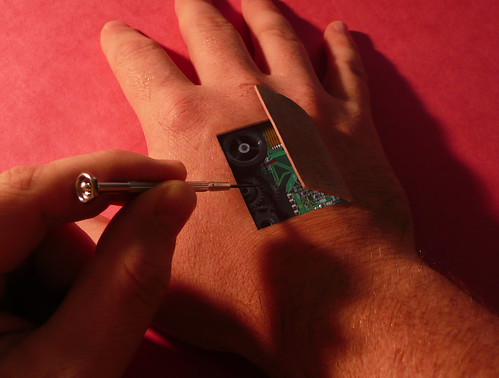
Late last week a user asked for a new feature.1  He wanted to be able to perform the Ogilvie DFEC rebuttal calculation and have the results e-mailed to him.2 Well, I built it!3

To e-mail yourself a calculation, perform the calculation as normal.  When the website returns your calculation, it will say “E-mail Me!”  Just click that button and it will send an e-mail to the address you used to register for this website.

However, here’s the cool part:  I’ve installed this new e-mail system into every calculator4 No more having to copy and paste!  Just click one button and your calculation will show up in your inbox!5

Although I intend this to be a paid-subscription-only feature, I am going to leave it open for all users while I get some feedback.  So, what do you think?  Please leave a comment or shoot me an e-mail!

  1. Thanks Dennis! []
  2. Photo courtesy of Vernhart []
  3. Why, what did you do with your Saturday morning? []
  4. I haven’t installed it in some of the EAMS lookup functions []
  5. If you filled in the boxes for Applicant, WCAB #, and File #, it will include this information in your e-mail as well.  This is only for your convenience and not a requirement. []

Indy 500
Indy 500

Wow!  500 registered users!

Last month I mentioned that this website had a record number of new visitors.  I honestly thought that was an anomalous one day spike in traffic.  Instead we’ve had a sustained increase in new visitors and people signing up to use the workers’ compensation calculators for free.

Since February 13, 20091 I’ve enjoyed posting about:

Ever since I relaunched this website I’ve had this idea in the back of my mind that getting to 500 users would be a big deal.  There are literally hundreds of workers’ compensation professionals who rely on this website and its calculators to make their lives a little easier.  This certainly feels like a big deal to me.

  1. When the 400th user registered. []
  2. I am keeping this calculator in beta testing until I get a little more feedback.  If you want to try it out, just drop me a line! []

XYZZXSJO2 - The motion picture!
XYZZXSJO2 - The sequel!

Last week I posted about a recent case from the San Jose WCAB that indicated a life pension SAWW1 increase is applied on the first January 1 after the date of injury.  You can find a download of the XYZZXSJO2 case here.

I’ve just finished the COLA / SAWW future life pension rate calculator to determine what the future life pension rates are assuming a COLA / SAWW increase of 4.7% per year.  If you’re interested in becoming a beta tester for this COLA / SAWW calculator for life pension increases, please drop me a line and ask for access. 2

Please keep in mind that this is not a life pension with SAWW / COLA increase commutation calculator.  The actuarial math involved in performing that calculation is … intense.

As an interesting side note, this week I saw my very first DEU commutation of a life pension with COLA increase.  Unlike the typical commutations everyone receives from the DEU, this commutation calculation was devoid of the actual methodology used.  I was pretty disappointed to find this out.

No matter!  Help beta test the new calculator by dropping me a line.  After you’ve given it a whirl, let me know what you think.

  1. SAWW means State Average Weekly Wage []
  2. If you have already helped me out as a beta tester, you already have access to this calculator. []

XYZZXSJO2 - The motion picture!

Last week while Steve was at the Sacramento WCAB he heard about a recent case that held the COLA / SAWW adjustments and increases are calculated based upon the first January 1 following the date of injury. 12

This case involving SIF (the subsequent injuries fund) is from the San Jose WCAB.  The name of the case is “XYZZXSJO2 v. Subsequent Injuries Benefits Trust Fund, ADJ 1510738, SJO 0251902”.  The name of the Applicant was anonymized to protect their identity.  34

Download a copy of XYZZXSJO2 now!

Thus far the conventional wisdom has been that the COLA/SAWW increases are calculated starting with the first January 1 after life pension gets paid out.  This is a tremendous change in the COLA/SAWW calculation of life pension.

Assuming a 1/1/2003 injury at exactly 70% permanent partial disability, there would be 426.5 weeks of permanent disability paid after the permanent and stationary date before the life pension gets paid out.  This equates to 8.2 years from the permanent and stationary date that has, thus far, not been taken into account with life pension calculations to date.  To put this in perspective, if someone had an injury on 1/1/2003 and became P&S on that same date5 , the traditional method of calculating the life pension with COLA / SAWW increase would be too low by approximately 44%.

At the moment I’m finalizing a COLA / SAWW life pension calculator to determine what the future life pension rates are assuming a COLA / SAWW increase of 4.7% per year.  If you’re interested in becoming a beta tester for this COLA / SAWW calculator for life pension increases, please drop me a line and ask for access.

Unfortunately, I don’t have a citation for the 4.7% COLA / SAWW increase, but I believe it to be the offiical average used by the DEU6 to calculate commutations of COLA / SAWW increases and adjustments.  If you have an official citation or document from the DEU, please drop me a line so I can include that citation here!

  1. COLA = cost of living adjustment. []
  2. SAWW = state average weekly wage. []
  3. I hope to have a scan of this decision for you soon! []
  4. David DePaolo of WorkCompCentral.com has graciously allowed me permission to offer you a copy of XYZZXSJO2 for download!  Thanks David! []
  5. Not likely. []
  6. Disaiblity Evaluation Unit. []

PDRater.com breaks another record!

I’m out of the office for one lousy day and what happens?  A record number of visitors to PDRater.com, that’s what.1  I suppose I should spend more time up at the Santa Rosa WCAB, eh?

On Wednesday February 18, 2009 this website had a record number of individual visitors.  On that day I  234 unique visitors.  2  In the grand scheme of things, this is a fairly low number of unique visitors to a website.

However, most people come to this website looking for information about California workers’ compensation, workers’ compensation resources, workers’ compensation calculators, and updates regarding recent workers’ compensation cases.  The vast majority of website visitors (I’m extrapolating from those who have signed up for free) are claims adjusters, law office staff, and applicant and defense attorneys.

This sort of website traffic is considered to be very “high quality” as in the number of people from my target demographic comprise the vast majority of those people who actually visit my site.

  1. Photo courtesy of Ann Althouse. []
  2. The previous record of 180 visitors was set on August 23, 2008. []

Workers Compensation Calculator
Workers' Compensation Calculator

I had an interesting e-mail exchange with a friend (and fellow workers’ compensation professional) the other day.1

We were discussing the impacts of Ogilvie on 2005 schedule ratings.  He had asked me whether I intended to update the 2005 permanent disability rating calculator to include FEC Ranks after the scheduled 8.  I believe he had suggested FEC Ranks 9 through 20.

I have no intention of manufacturing FEC Ranks 9 through 20 for the following reasons:

  • Maintaining Standards. The entire point of a rating schedule is to allow a standardized method for calculating disability and expressing those disability calculations.   If I invented my own FEC Rank system beyond the scheduled 1-8 Ranks, I would essentially be creating my own rating calculation system.  I’ve gone to considerable lengths to ensure that the rating strings produced by these permanent disability calculators are as standardized, recognizeable, and universal as possible.
  • FEC Ranks are Irrelevant. The FEC Rank system is a simplified method of applying DFEC adjustment factors.  When you use the FEC Rank of a particular body part to adjust the standard using the charts on pages 2-6 and 2-7 of the 2005 PDRS (permanent disability rating schedule), what you’re really doing is essentially multiplying your standard disability against the FEC adjustment factor associated with the particular FEC Rank for the body part in question.  An FEC Rank is only useful for telling you the appropriate FEC adjustment factor to apply to the standard disability.  Thus, FEC Ranks are irrelevant and FEC adjustment factors are all important.
  • Arbitrary FEC Ranks. FEC Rank 1 has an FEC adjustment factor of “1.100”.  However, using the Ogilvie DFEC rebuttal formula, it is possible to end up with very low FEC adjustment factors.  In extreme circumstances it would be possible to have a negative FEC adjustment factor.  The only way to resolve this would be to have several possible negative FEC Ranks.  Besides being somewhat silly, worrying about additional FEC Ranks2 misses the point.  If you’re using the Ogilvie DFEC rebuttal formula properly, the result will be a new FEC adjustment factor.  If you already have the FEC adjustment factor, you have no need for the FEC Rank!

When I had discussed the impact of Ogilvie earlier, I had pointed out that in some cases the resulting formula will dictate that you use a different FEC Rank than the one indicated by the affected body part.  In other cases you will need to use an entirely new FEC adjustment factor.  In order to keep the 2005 disability calculator current I will eventually have to create a way for the user to override a body part’s standard FEC Rank and specify a new FEC Rank or their own FEC adjustment factor.

I’m not in any particular rush to develop this feature since Ogilvie seems to require three years of post-injury earnings.  I doubt we’re going to see litigation begin in earnest over Ogilvie issues for another 18 to 24 months.

  1. Photo courtesy of Street Fly JZ []
  2. Both higher and lower than the normal 8 []

Refresh for updates
Refresh for updates

In no particular order:1

  • I often refer to myself as a Workers’ Compensation nerd.  The other day I realized that would be a GREAT website name!  Unfortunately, WCNerd.com is already taken by “white collar nerd.”  Bummer, no?  What a great e-mail address that would have been, too!
  • With well over a 100 posts and counting I thought it was time to include a “tag cloud.”  Its on the bottom of the right sidebar of this website.  Its basically a grouping of the common words I use to tag various posts.  The more common a word is the larger it appears.  The top contenders are pretty telling
  • To help with the website navigation and use of the “tag cloud” I’ve started being more liberal with how I tag my various posts.  Its actually kinda fun.
  • I’m  using a new e-mail contact form.  I was using “Contact Form 7,” which has a truly impressive feature list. While effective, I didn’t much care for this plugin because of its complexity.  What I really wanted was a quick and easy way for website visitors to send me e-mail.  Recently I found “Tiny Contact Form” by Tom Braider to be exactly what I needed.  It is small, simple to configure, and easy to include.  I’m actually using a modified version of the really fantastic “Tiny Contact Form” plugin.  I’m rather proud of my modification on this plugin and even sent Tom Braider my changes which he ended up incorporating into the next version!
  • Google recently swallowed up Feedburner.  I was using Feedburner to manage the RSS feeds for this website.  The only problem was that it was causing all kinds of problems.  My RSS reader wasn’t picking up the new posts from my own blog!  So, I scrapped the Feedburner management of my RSS feed and went back to the native WordPress support for RSS (which is pretty damn good).
  1. Photo courtesy of RandomChu []

1955 Packard 400
1955 Packard 400

February has been a wacky month.  And, on Friday February 13th the 400th user registered for this website. 1 Since the 300th registered user, quite a lot has happened:

  1. Photo courtesy of atxbill []
  2. Trust me, its easier than it sounds… []
  3. I have several more of these planned []

Wordpress Upgrade
Wordpress Upgrade

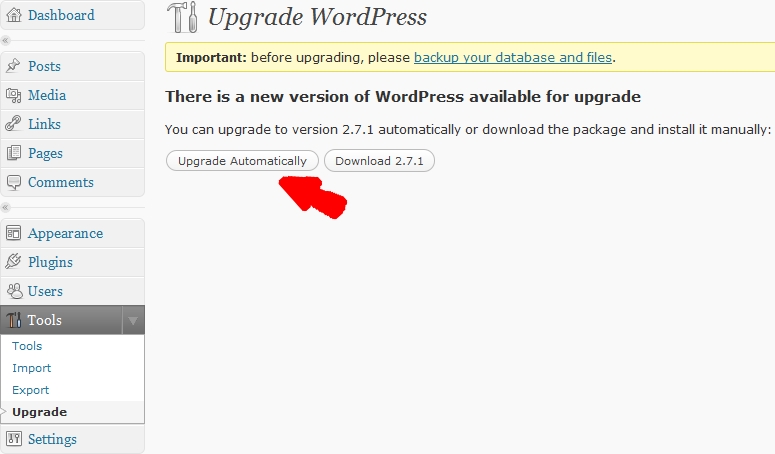
I upgraded to WordPress v2.7.1 as soon as it came out (after testing on another website, of course).  I can honestly say WordPress is the only software I use that I actually look forward to upgrading.

Since version 2.7 RC 1, upgrading to the next version of WordPress has been this easy:

How to Upgrade WordPress

You click “Upgrade Automatically” and wait about 5 seconds.

You’re done.

Not entirely off topic: a friend of mine asked me yesterday about the best way to put up a new website.  She had thought about using Yahoo Site Builder or some such.  Yahoo and its like are great at building free, quick, and ugly websites.  If you’re going to publish on the internets, why not just opt for something just as easy and that has hundreds, if not thousands of possible totally free themes to choose from?  I say, go with WordPress.

I used to code sites by hand – that’s a chump’s game.  Just install WordPress and call it a day.

So Many Calclators, So Little Time

After some additional testing and feedback, I have launched the Ogilvie Calculator aka DFEC Calculator aka Diminished Future Earning Capacity Calculator.1

To all of my friendly beta-testers:  Thank you!

So, what are you waiting for?  Signing up for this website is totally free and takes 30 seconds.  Log in, give it a whirl and let me know what you think.

  1. Photo courtesy of teclasorg. []